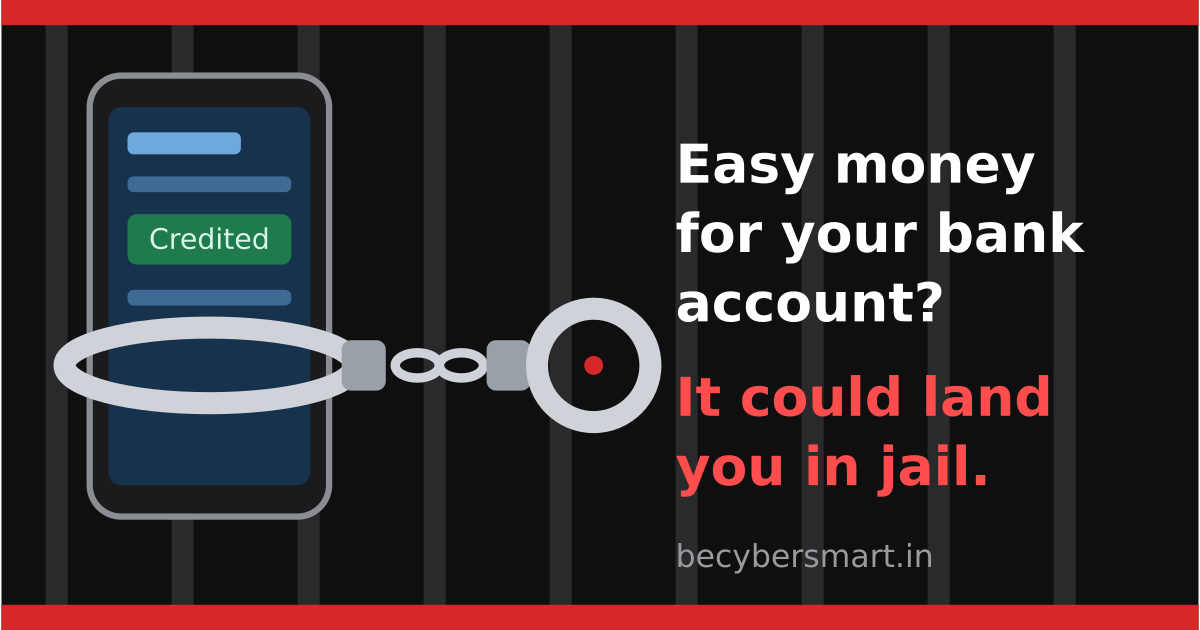
Rs 5,000 for Your Bank Account? That Is the Mule Account Trap
A group of students in Kerala went on a trip. They paid for it with money they were given for letting someone use their bank accounts.
What they did not know: Rs 20 lakh of fraud money had passed through those accounts.
They did not hack anyone. They did not steal anything. They said yes to an offer that sounded too easy to be wrong. And because the money moved through accounts with their names on them, the questions went to them first.
This is the mule account scam. It is one of the fastest-growing frauds in India, and it targets exactly the people who need money the most.
The one rule to remember
Your bank account is not yours to rent, sell or lend. Not for a day. Not for Rs 5,000. Not for a friend.
If a “job” asks you to receive money and send it on, it is not a job. You are the delivery route for stolen money.
What is a mule account, in one minute
A mule account is a real person’s bank account that fraudsters use to receive, hold and forward stolen money. Victims of fraud send money in. It is moved out within minutes. When police trace the trail, the first name they find is the account holder’s.
Many holders do not realise what they are part of. That does not stop the freeze. Keralam Police say account holders bear full responsibility for the transactions in their accounts.
Why this is in the news right now
Police in many states are now going after the account holders themselves:
- Pimpri-Chinchwad (Pune): Cyber police registered cases against five mule account holders and warned students and youth in July 2026. Reports say about 60 people were booked within 15 days.
- Kasaragod (Kerala): Police booked 26 people in September 2026 in a crackdown on people who rent out their accounts.
- Wayanad (Kerala): More than 500 youths were reportedly caught up in one mule account racket.
- Haryana: Police have called mule accounts a major tool of cyber fraud.
The pattern is the same everywhere. The holder gets a small amount. The fraud that passes through can be lakhs or crores.
Where the offer comes from
It rarely says “mule account”. It arrives dressed as something else:
- A job. Work from home. Part-time online work. Easy commission. “Park money in your account for a small fee.” RBI’s own advisory notes that fraudsters use keywords like “Earn Online” and “Part Time Job” so their ads match what people search for.
- A hiring process. A student is told to open a new account as part of joining. Then they are told they did not get the job. The account is used for crime later.
- A “business” favour. In Bengaluru, police busted a gang that befriended students in paying-guest accommodations and convinced them to open accounts for a “currency exchange” business. The accounts were later used for cyber fraud.
- An instant loan. “Money in minutes.” You share KYC documents. In an Indore racket, accounts were opened in victims’ names using their own documents.
- An account rent. Kerala police report offers of Rs 3,000 to Rs 10,000 per transaction for students, the unemployed and people in financial trouble. In one case, a rubber tapper opened three accounts and sent the ATM cards and PINs to a gang that had befriended her on social media.
- A friend. In Jaipur, police arrested two youths, aged 19 and 20, who recruited students at tea stalls and cafes. In an Indore digital arrest case, one student gave his account to a friend, who passed it on. The students got Rs 5,000 to Rs 30,000 each.
- A social media ad. I4C says cybercriminals scout for accounts mainly on Telegram and Facebook.
- A bank insider. A bank assistant manager was arrested for opening accounts of unsuspecting people and handing control to a syndicate.
Look at the numbers
A labourer in Sangli was paid Rs 23,000. In two days, his account moved Rs 90 lakh.
In a Bengaluru case, the commission was Rs 4,000 on a Rs 1 lakh transaction.
In one Kasaragod case, police found transactions of Rs 9.10 lakh through a single account.
The person who owns the account takes the risk. The person who runs the scam keeps almost all of the money.
What happens next
- Your account is frozen. Many people find out only when a UPI payment or salary withdrawal fails.
- You cannot just ask the bank to release the money. Banks cannot release frozen funds without a court order.
- The police may call you. Maharashtra Cyber police issued an advisory on 14 October 2026 warning of frozen accounts and legal action against people who let their accounts be used.
And “nobody will notice” is no longer a safe bet. RBI’s MuleHunter.AI tool uses machine learning to flag suspicious accounts, and the Finance Ministry has pushed banks to adopt it.
How to never get into this
1. Ask the 4-question test. Before you say yes to any money offer, ask:
- Does this need my bank account, UPI ID, SIM or documents?
- Am I receiving money from someone I do not know?
- Am I being asked to send it on to someone else?
- Is someone paying me just for “allowing” this?
If the answer to even one is yes, it is a mule account offer. Walk away.
2. Know the things you never hand over. I4C, the Indian Cyber Crime Coordination Centre, advises people never to rent, sell or lend a bank account, SIM, passbook, ATM card or company registration certificate.
3. Real employers pay you, not the other way round. A real job pays your salary into your account. It does not ask you to receive a customer’s money and forward it. A real job also does not ask you to open a new account for the company. A Haryana police officer put it simply: no legitimate employer or institution uses an individual’s personal bank account for its transactions. If anyone proposes it, treat it as a warning sign of cybercrime.
4. Do not open an account because someone told you to. If a recruiter or loan agent asks you to open a bank account “for the process”, stop. Check the company on its official website, and call the number printed there, not the number the recruiter gave you. Bank advisories based on RBI guidance say the same: do not open a bank account at someone else’s direction.
5. Friends can be recruiters too. The Jaipur and Indore cases both involved friends and friends of friends. A familiar face does not make the offer safe.
6. “Just this once” is how it starts. Many people only gave access once. Once is enough.
7. Be wary of ads and “friends” who appear out of nowhere. Telegram and Facebook ads, WhatsApp “job” messages and a new online friend who needs “a little help” are all common routes.
8. Report the offer. A Bank of India customer notice says to report any rent-an-account approach to your bank, the platform involved, and the police or cyber cell. Reporting protects you, and the next student.
What to say when someone offers you money for your account
You do not need a long reason. Keep it short:
- “No, I do not give my account to anyone.”
- “If this is a real job, pay me my salary into my own account.”
- “I am checking this with the bank.” (Then actually do it.)
- “My bank account is only for my own use. Please do not contact me again.”
Then stop replying. Block the number. Take screenshots first, in case you need them later.
If you are already caught
Do not ignore it.
- Stop all activity. Do not let anyone else use the account, and do not send or receive anything more for them.
- Call 1930 or report at cybercrime.gov.in. Reporting early shows you are not hiding anything.
- Write to your bank. Send a written grievance with your account statements and proof that your own transactions were legitimate. Ask for an NOC so the account can be unfrozen.
- Keep every record. Chats, call logs, names, UPI IDs and any payment you received.
- If the freeze drags on or you get a police notice, speak to a lawyer.
This post is general awareness, not legal advice. Laws and penalties differ by case.
Share this with the people who need it most
The people who get recruited are not careless. They are short of money, and someone is offering a way out and calling it harmless.
Send this to your college group, your cousins and the family WhatsApp group. Tell them one line: “Your account, their crime. Never rent it.”
Want to test yourself? The free 3-minute daily quiz at becybersmart.in has real scam scenarios like this one, in English, Hindi, Marathi and Tamil.




2 Comments